

Anthropic began trading on Nasdaq last week. The opening price gave the company a brief valuation of roughly $2 trillion on a fully diluted basis. By the close, it was closer to $1.77 trillion. Both numbers describe the AI frenzy. Neither tells us much about the companies that may be founded over the next decade by people who worked there.
That may prove the more interesting consequence of the listing. One estimate reported by Reuters put the number of current and former Anthropic employees holding at least $1 million in vested, pre-tax equity at roughly 2,800, based on an assumed $1.35 trillion valuation. The estimate is modelled, and equity value can take time to become cash. OpenAI has also confidentially filed for an IPO, with a 2027 listing reported as a possibility. The exact count of new millionaires will move with share prices and the mechanics of each offering. The more durable question is what a cohort with unusual technical experience, strong professional ties and greater financial independence will choose to do.
Every boom trains people for the next one
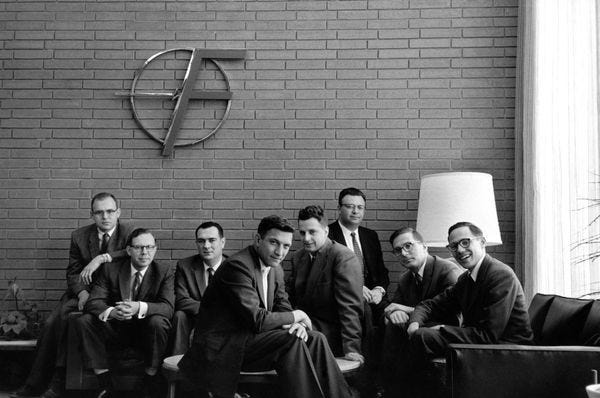
The useful thing about the PayPal precedent is how little the next generation resembled PayPal. Reid Hoffman went on to found LinkedIn. Former PayPal employees helped build YouTube and Yelp. Others became investors. The shared experience was in payments. The companies that followed went after problems in professional identity, video and local discovery.
Working together through a period of rapid growth gives people information about one another that is hard to acquire any other way. They know who stays effective when a system fails, who can recruit exceptional people and whose judgement holds up when there is very little evidence to go on. Years later, that knowledge can be the basis of a founding team or an angel cheque written before there is much of a product to evaluate.
The IPO matters because it changes who can act on that knowledge. Someone who might once have needed to join another company can spend a year investigating a problem. A founder can raise an early round from people who understand what she is trying to build and have worked with her long enough to trust her judgement. These are small decisions individually. When many people from the same company can make them within a few years of each other, they can change what an ecosystem is willing to finance.
The second wave may be hard to recognise as AI
The first wave organised much of the industry around a clear objective: build more capable general-purpose models. The people doing that work also had a close view of the problems that persisted as the models improved. A system could generate a convincing answer while a customer still had no reliable way to evaluate it. A model might be able to do a task while the organisation deploying it had no appetite to give it the authority to act. These problems are easy to classify as implementation details until someone has to build a business around solving one of them.
Consider what happens when engineering teams can generate several plausible designs in the time it used to take to develop one. The valuable business might be the one that helps customers establish which design can be certified, manufactured and maintained. It could look more like an engineering or testing company than a descendant of a frontier lab. One way to look for the second wave is to ask which activities become more expensive, more important or more difficult to coordinate when intelligence itself becomes cheaper.
There is also a case for scepticism. An alumni network can make it easier to finance an unconventional idea. It can just as easily turn a set of shared assumptions into twenty well-funded companies pursuing variations of the same thing. The advantage of having worked at the frontier is knowing where the frontier is. The disadvantage may be having spent years looking in the same direction.
Where does the next wave land?
San Francisco has a good chance of retaining much of the early activity. The first people you call when you leave a company tend to be the people you already know. A few such calls can give you a co-founder, a first cheque and a place to work before anyone has made a deliberate decision about geography.
The more interesting question for us is where those companies have to go once they find a problem worth pursuing. If the opportunity is in industrial engineering, the earliest customer may be a manufacturer whose production lines are in Germany or Japan. If it is in logistics, the best place to understand the problem may be a port in Singapore. The founding network can stay concentrated while the expertise, customers and infrastructure that determine the company’s trajectory sit elsewhere. Other ecosystems have an opening wherever they can give founders access to a problem they could spend years trying to understand from a distance.
The public market will spend the next few quarters asking whether Anthropic can grow into its valuation. We’ll be watching a slower development: where its alumni go, which problems they choose and who is willing to finance them before the opportunity has a familiar name. The companies that tell us most about this wave may be the ones we would never think to put on an AI market map today.
If a customer goes from reviewing two designs to reviewing twenty, who gets paid more? It might be whoever can rule out eighteen quickly and explain why the remaining two are worth testing. I wonder how many of the best businesses in this wave will come from following the cost of verification.
The distinction between doing a task and having the authority to do it feels underexplored. A model can recommend releasing a batch, but someone still has to sign the release and explain it to an auditor six months later. There’s a company to build around making that decision defensible.