

In early-stage deep tech, the investor does not back a finished asset. What is being financed is a sequence of future states: a prototype that will reach industrial performance, a certification that will unlock a market, a manufacturing line that will deliver at scale, a customer agreement that will become recurring demand. The roadmap is therefore more than a description of execution. It is part of the asset itself, because a large share of today’s valuation rests on what those milestones are expected to make possible tomorrow.
That is why due diligence cannot end with the question of whether management’s plan is credible. It rather challenges whether the world around the company will continue to give each milestone the meaning the investment case assumes. When markets are relatively stable, investors can compare a roadmap with familiar precedents: the usual duration of a qualification cycle, the recognised force of a contract, the normal availability of an industrial input. In a market being reshaped by scarcity, regulation or concentrated demand, those precedents can become unreliable before the language of investment committees has caught up.
The overheating of the data centre market makes this problem unusually visible. It is not the only sector in which it appears, and it is not the destination of the argument. It is a useful lens through which to examine a broader deep tech question we often face: what happens when the commercial promise remains legible, but the standards that once translated that promise into an investable asset begin to move?
When scarcity changes the milestone
A heated market does more than lift prices and lengthen queues. At a certain point, scarcity begins to alter the asset being bought. A grid connection may still be called a connection while offering a weaker claim on firm power. A supply agreement may secure a place in a manufacturer’s order book without securing the delivery date embedded in the revenue plan. A regulatory designation may remain valid while covering a narrower use, geography or production scale than the model assumes. The familiar milestone survives, but the economic right beneath it becomes conditional, divisible or exposed to a new counterparty.
This is a more difficult form of market risk than ordinary volatility. An increase in price is visible and can be reflected in a model. A change in meaning is easier to miss because the vocabulary remains intact. The company can accurately say that power is secured, a product is certified or capacity has been reserved, while the investor hears the stronger version of those claims inherited from an earlier market. The resulting distortion is rarely a simple falsehood. It is a gap between the promise contained in the roadmap and the rights that now sit behind the words used to describe it.
The data centre market makes the shift visible
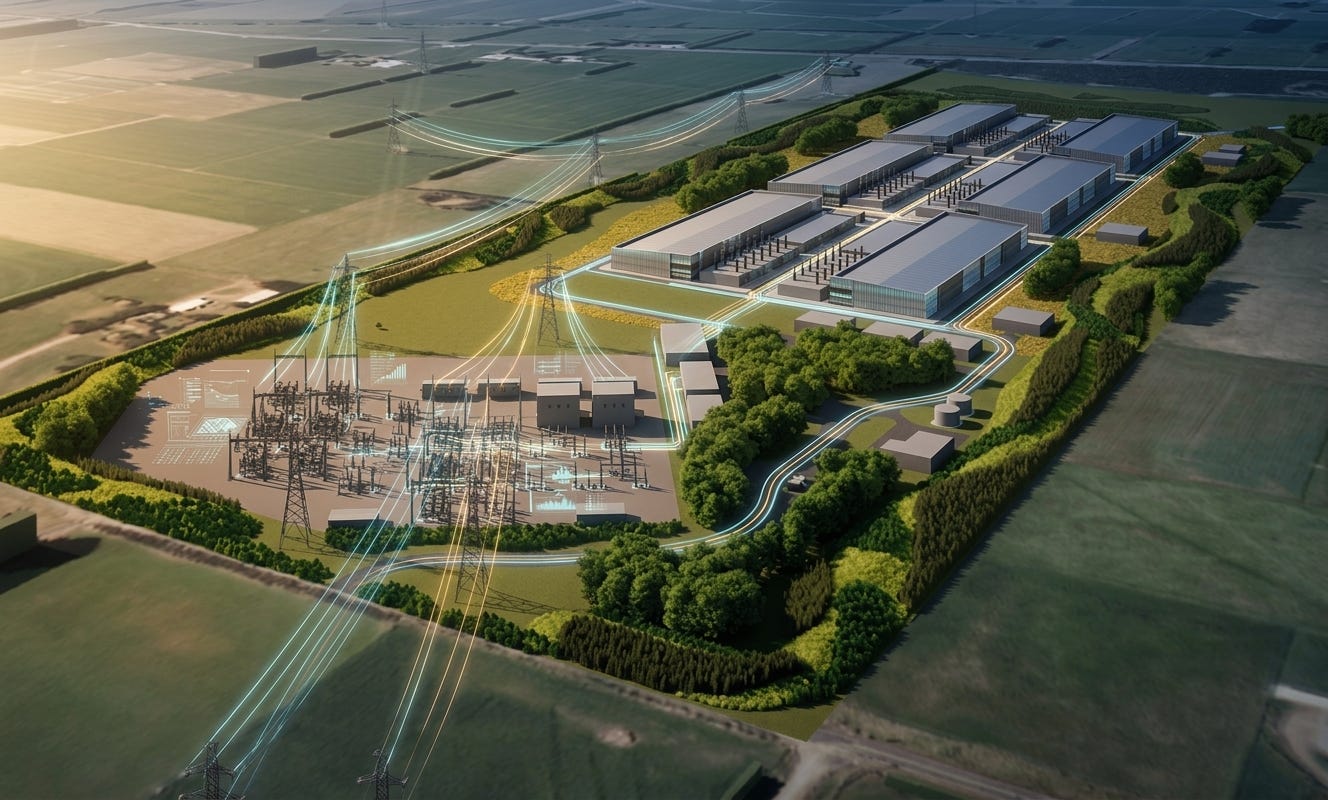
PJM offers a clear example. In August 2026, the grid operator proposed allowing large new customers to connect even when the system had not secured enough generation to cover their full demand. The trade-off is simple: when power is scarce, the uncovered portion of their demand would be curtailed first. The proposal does not create more electricity. It changes what a grid connection means.
That distinction matters because PJM is already short of capacity. Its latest auction secured 138,318 MW and, even after counting supply committed outside the auction, left the system 6,831 MW below its own reliability requirement. Prices cleared at the regulatory ceiling. A project can therefore meet a milestone such as connected by Q3 2028 while still lacking an unconditional right to draw its full power requirement. The date has not moved. What the date represents has.
Recent events show how quickly these distinctions become material. In northern Virginia, a transmission fault in July triggered roughly 3,800 MW of data-centre demand to disconnect and switch to on-site generation. PJM concluded that the protective equipment had been set too cautiously: systems designed to protect individual facilities had become, at scale, a reliability issue for the wider grid. The equipment had not changed. The standard against which it was judged had.
Texas provides a different version of the same problem. Big Digital Energy announced a site with 311 MW of headline capacity. Its own disclosures reveal three very different assets beneath that number: 17 MW operating today; up to 111 MW of grid power still awaiting validation; and the balance dependent on gas generation that has yet to be built. Two weeks later, the company described the site as supporting up to 300 MW of total buildout. None of this makes the project weak, nor does it require assuming that anyone is misleading investors. The point is that a single headline can collapse three different states into one number: operating capacity, conditional capacity and future optionality. For an investor, they should not carry the same weight.
Diligence between the roadmap and the market
For early-stage investors, the implication is not to replace conviction with suspicion. It is to locate conviction more precisely. A deeptech roadmap already asks the investment team to judge technical progress, commercial adoption and the company’s ability to finance the journey between them.
The additional task is to identify which milestones depend on external systems whose own rules are changing. A certification date depends on the capacity and interpretation of a regulator. A scale-up plan depends on equipment lead times, specialist labour and suppliers that may be serving an entire wave of competing projects. A customer commitment depends on the legal force of the document, but also on the customer’s ability to absorb the product when it arrives. The company controls part of the roadmap; the market, infrastructure and institutions control another part.
Evidence must therefore be read in relation to the claim it is being asked to support. A useful hierarchy has four levels. Binding evidence — a signed agreement with the party controlling the resource, a final regulatory approval or another enforceable right — can justify a high degree of confidence. Project-specific evidence — a place in a queue, a completed study or a defined scope of required upgrades — establishes that a project has reached an earlier, but still conditional, state. Operational evidence — equipment installed and tested, permits in hand or fuel contracted — demonstrates that the asset can work, but not necessarily that it is entitled to operate at the level or on the timeline assumed. Directional evidence — forecasts, auction results or proposed rules — indicates where the market is heading rather than establishing a right the company actually holds. The analytical error is almost always the same: an investment deck uses level-four evidence to make a level-one claim. In a crowded market, that distinction becomes even more important because the queue, the rule and the relevant standard may all move while the company is executing against them.
One question separates the two faster than any checklist. For this exact site or unit, show me the binding document proving you can operate at the promised level on the promised date, and identify every condition under which that right can be reduced or suspended.
From a diligence snapshot to a living conviction
Traditional diligence is organised around a transaction and therefore tends to produce a snapshot. Deep tech investment unfolds over years, during which the environment surrounding the roadmap can change repeatedly. The more useful model is a living investment conviction: a small number of valuation critical claims are identified at entry, the evidence behind them is made explicit, and the external conditions on which they depend are followed over time. When a regulator introduces an interim category, when a waiting list becomes longer than the company’s build cycle, when established buyers contract years ahead or when a new reporting obligation begins to expose data that did not previously exist, the investor has an early indication that a milestone may no longer mean what it meant at underwriting.
This is where AI-assisted analysis can become genuinely useful. Its value is not in producing another generic diligence report or substituting automated confidence for investment judgement. It lies in continuously reading a fragmented field of regulatory filings, technical notices, company disclosures and market signals, then reconnecting those changes to the few assumptions carrying the roadmap. Used well, such a system can show that a claim has strengthened, that an external dependency has become more fragile, or that the market has begun to redefine the category in which the asset was originally assessed. The objective is not permanent doubt. It is a more durable form of conviction, one that remains connected to the physical, institutional and commercial reality through which deep technologies must eventually scale.
—
About the contributor
Eden Djanashvili runs DeepRadar, an independent practice that checks whether a company’s promises to investors still hold. She reads the contracts and filings behind those promises. When one stops holding, she tells investors before it’s too late to reprice, renegotiate or walk away. She is a jury expert for the European Innovation Council and lectures at ESADE and UPC. console.deepradar.tech

The distinction between a milestone being achieved and the underlying economic right actually being secured is particularly important. Investors spend a lot of time diligencing whether a company can execute its roadmap, and perhaps not enough asking whether the external system will still assign the same value to each milestone when it gets there.
Thanks Eden for sharing your insights and ongoing work!